Your request goes to a Pierce County pro who takes ductwork jobs.
You noticed something. A musty smell when the furnace kicks on, dark spots around a vent cover, or someone in the house coughing more than they used to. In the Tacoma area, where the furnace runs most of the year and the air conditioning barely gets used, ducts stay damp less from humidity outside and more from condensation inside the system itself. That moisture is what mold needs.
Air ducts are closed up and hard to see into. You can wipe a vent cover clean and still have no idea what the inside of that ductwork looks like ten feet back. A real inspection means a camera or a trained eye checking the registers, the return side, and the coil near the air handler, not a guess based on smell alone.
This is also not a job for someone who cleans ducts once in a while as a side service. Mold in ductwork calls for someone who deals with Pierce County homes and this climate specifically, who knows where moisture tends to collect in a system that heats far more than it cools, and who has seen what a few decades of that pattern does to the inside of a duct run.
When you ask for help here, you're not handed a list of names to call one by one. You get matched with a single contractor who works on duct systems like yours in this area, and that contractor contacts you directly. No chasing down quotes from five different companies, no explaining your situation over and over. One contractor, already familiar with what shows up in homes around Tacoma, reaching out to look at what's actually happening in your ducts.
From there, the next step is simple. Answer a few questions about your situation and what you're seeing, and let the matching happen.
Can mold actually grow inside my air ducts?
You saw dark spots around a vent cover or caught a musty smell when the furnace kicks on, and now you're wondering if that's really mold or just dust. It's a fair question. Ducts seem like the wrong place for anything to grow, since there's no food or light in there. But the conditions inside them aren't as dry and empty as most people assume.
Yes, if moisture gets in and stays
Mold needs moisture, a surface to sit on, and something organic to feed on, and ductwork can give it all three. Condensation forms on duct walls when warm, moist air meets a cool surface, which happens around the parts of the system that handle cooling or sit in an unheated crawlspace or attic. Dust that collects inside the duct gives mold something to feed on once that moisture is there. Once it takes hold, running the furnace spreads spores through the house instead of clearing them out, since the air moving through the ducts picks up whatever is growing on the walls and carries it into every room the system serves.
Mold needs standing moisture, and a duct system gives it plenty of chances to find some. The evaporator coil in the air handler runs wet while the system is on, and that's usually where spores land first and get a foothold. From there it doesn't take much. Dust already sitting in the ductwork works like food for the colony, so a duct that hasn't been cleaned in a while grows mold faster than one that has. Ducts running through a crawlspace or attic add another path in, since small gaps let outside moisture reach the metal even when the house itself stays dry. Once mold is established anywhere in the system, the blower does the rest of the work for it, carrying spores past that section and out through every vent on the line. That's why the smell doesn't stay put. A musty smell that shows up when the furnace kicks on and fades when it shuts off is coming from moving air, not from one room with a hidden problem.
How mold actually spreads through ductwork
Mold needs moisture to grow, and a duct system collects it wherever condensation forms on a cold coil or a poorly sealed joint.
The evaporator coil in the air handler stays wet while the system runs, and any spores drifting past can settle and take hold there first.
Dust sitting in the duct gives mold something to feed on, which is why a dusty system grows a colony faster than a clean one.
A duct that runs through a crawlspace or attic can pick up outside moisture through small gaps, feeding growth even when the inside of the house stays dry.
Once mold takes hold on one section of ductwork, the blower pushes spores past it and out through every vent the duct feeds.
A musty smell that comes and goes with the furnace, rather than sitting in one room, usually means the source is moving air, not a fixed spot in the house.
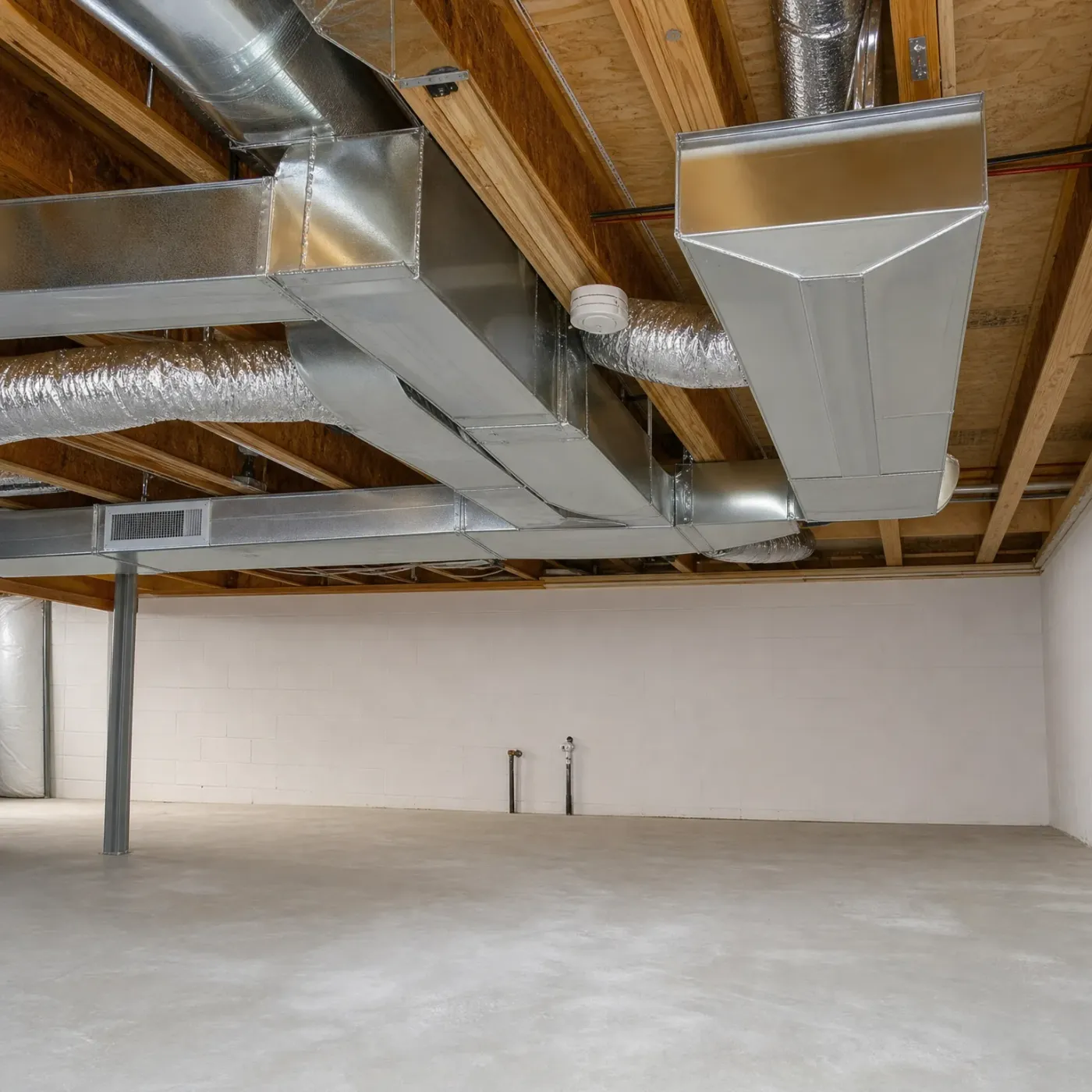
Clean ductwork does its job out of sight, moving air through dry metal and sealed joints with nothing growing inside.
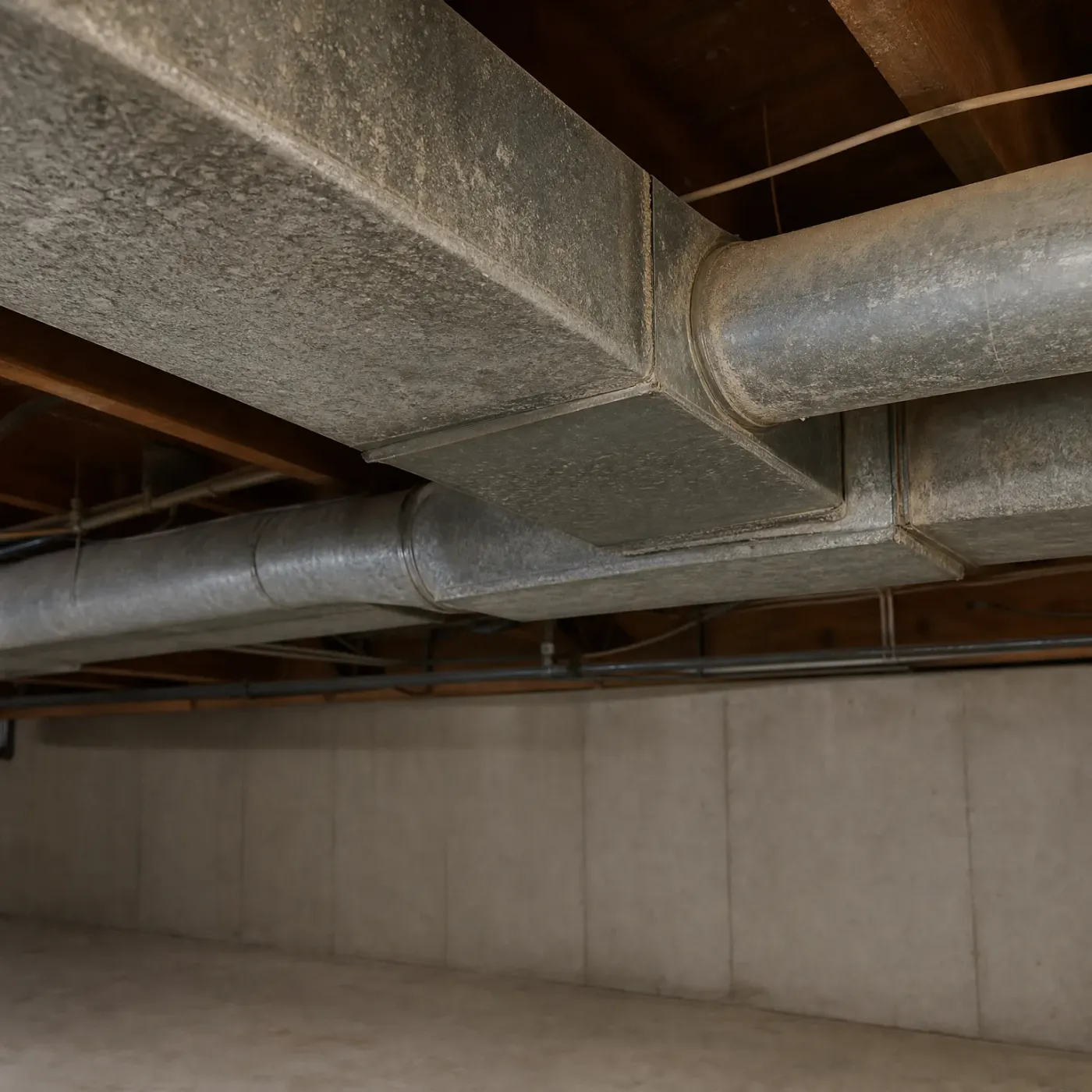
Dust and grime caked on the duct and joists like this usually mean moisture has been sitting somewhere in the system.
What does your duct system have to put up with here?
Half the homes here were built by 1986
Heat runs through your ducts from September through June here. That's ten months of warm air moving through the same metal, carrying dust and any moisture sitting in the system along with it.
Heat runs September through June
Half the homes in Pierce County were built in 1986 or earlier. If yours is one of them, the ductwork has had decades to develop joints that leak or seams that sweat.
Power here costs 13.52 cents per kilowatt-hour
Power here runs 13.52 cents per kilowatt-hour, cheap enough that most homes heat with electric furnaces or heat pumps that run often. More runtime means more chances for dust and moisture to build up inside the ducts.
The pro who gets in touch is licensed in Washington and works in Pierce County.
Asking costs nothing, and the choice to hire stays yours.
Why the furnace side matters most
Most homes in the Tacoma area heat with electricity, and that furnace or heat pump pushes air through the same ducts for ten months running. Every pass moves whatever is sitting in the metal, dust, spores, anything damp enough to cling to a joint. Air conditioning here barely runs, so it isn't drying the system out the way it might somewhere hotter. The furnace side of the system is doing almost all the work, which means it's also doing almost all the carrying. If mold has a foothold anywhere in the ducts, the months of heating are what spread it through the house.
What a sealed joint should look like
A duct joint that's sealed right stays dry on the inside no matter what the weather does outside. Water gets in through gaps at the seams, a disconnected section, or a return that pulls in damp air from a crawlspace or attic. Once that moisture is trapped against metal and dust, mold doesn't need much else. Checking the joints you can reach, at the plenum and near the air handler, tells you something real. Rust streaks, soft or sagging tape, or a damp smell right at the seam are signs water has been getting in, not just passing through.
Half the homes here were built by 1986
A duct system installed in the 1980s has had decades to collect dust, sagging joints, and spots where moisture settles. If your house dates back that far and the ductwork is original, that's a long stretch for grime to build up unseen.
ACS 2020-2024
Every time the furnace cycles on, that air passes over whatever is growing in the ducts first, then into the rooms where you sleep and eat.
You can't filter out a smell or stop spores at the vent cover. If it's in the duct, it's in your air, all ten months the furnace runs.
Before you get your ductwork cleaningAfter you get your ductwork cleaning
Ducts running clean
This is what a duct system looks like when it's doing its job. Sheet-metal supply lines and return ducts run along the joists, moving air through dry metal with every joint sealed tight. Nothing sitting in the corners, nothing growing where you can't see it.
Ducts in trouble
Here the ducts have been collecting more than air. Dust cakes along the seams where moisture has settled, and every joint is a spot that could be holding grime or worse. This is the ductwork a cleaning is meant to fix, not the furnace or the wiring running beside it.
A musty smell when the furnace kicks on or dark spots around a vent cover is worth checking, not worth ignoring. Ductwork that stays dry and sealed doesn't grow mold. Ductwork that's held moisture for years, especially if it's original to an older house, often does. A duct cleaning won't fix a leak or a sealing problem on its own, but it clears out what's already built up and gives you a clean look at the system so any real problem shows itself. From here, the useful step is getting someone to look at your ducts specifically, not a general rundown of what might be wrong. A local contractor who works on duct systems through the Tacoma winters knows which joints and sections tend to hold moisture in homes like yours, and you'll be matched with one contractor, not a handful of companies calling at once. You know what you saw and smelled. Now you know what it likely means, and who should take a look.
Find a duct system cleaning pro in Pierce County
A licensed pro who works in Pierce County gets your request.