Mini Split Installation in Longview, WA
Tell us about the house, and a licensed contractor who covers Cowlitz County will get in touch.
Tell us about the job
It takes about a minute.

Ten months a year of work, most of it heat
Longview needs heat from September through June. That is ten months a year, with winter nights averaging 33°F from December through February. A mini-split installed here spends most of its life in heating mode, not cooling. Summer afternoons average 74°F, so the cooling side barely gets tested.
Most homes in this area heat with electricity, so the heat pump is often doing the job a furnace would do elsewhere. Any mini-split installed new has to meet the federal minimum for split-system heat pumps, 14.3 SEER2 for cooling and 7.5 HSPF2 for heating. Cowlitz County has also seen 6 winter storms and 5 damaging wind events over the past ten years, and in Washington, close to a quarter of households lost power for at least a day in 2024. A mini-split has no pilot light to relight and no belt to check. When the power comes back, it starts on its own.
- 10 months
- September through June, your system heats
- 33°F
- the average winter night it heats against
- 74°F
- the average summer afternoon it cools against
Washington requires contractors to register with the state.
Registration means the business is on file with the Department of Labor and Industries. There's no trade exam behind it, and nothing about how the mini-split gets installed is checked at that point.
What actually confirms the installation was done right is the permit. Putting in a mini-split usually needs one from the local building office, along with an inspection once the work is finished. That inspection looks at the work itself, not the registration.
Source: Washington State Legislature
- Is a mini split worth it?
- For a lot of homes here, yes. Longview needs heat ten months of the year and barely any cooling, so a mini split earns its keep mostly as a heater. It pulls heat from outside air even when it's cold out, and it does that without ductwork. If your home already heats with electricity, which is true for most homes in this area, a mini split is often a more efficient way to deliver that heat than baseboard or a straight electric furnace.
- How many rooms can a mini split cover?
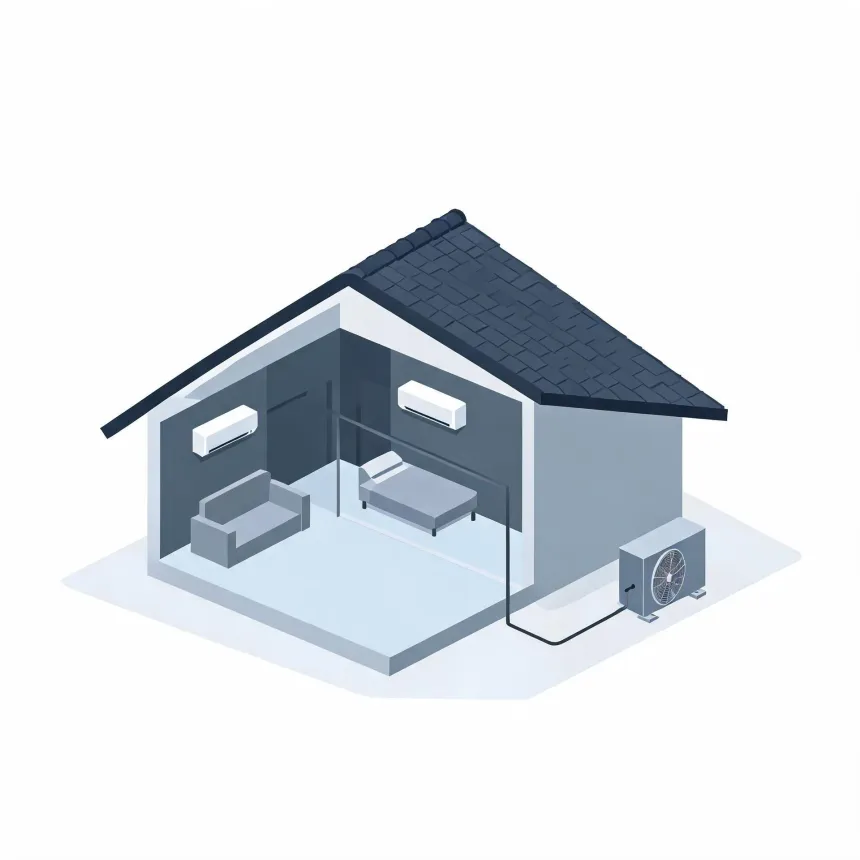
- A single indoor head is built to heat and cool one room or one open area well. If you need coverage in several separate rooms, a multi-zone system runs more than one indoor head off a single outdoor unit, and some outdoor units support five or more zones. How many zones your house needs comes down to the layout, the size of each room, and how the walls between them hold heat, which is why a contractor will want to walk the house before sizing it.
- Can a mini split heat a whole house?
- It can, if it's sized and placed for that. A whole-house mini split setup uses either several indoor heads on a multi-zone system, one for each main area, or ducted indoor units that push conditioned air through short duct runs into nearby rooms. What it takes to heat this house through a Longview winter, with lows near 33°F from December through February, depends on the square footage, the layout, and how the house is insulated, so that's a sizing job for a contractor to work out on site.